
Chapter 3 Downloads — Harmonics
Downloadable ECM book figures from Chapter 3. Each card includes a preview, a direct download button, and a full-size open link.
These images are provided for readers who want to reference the visual diagrams from the ECM book while reading the site pages.
Figure 3.1
Geometry of electroweak emergence in the ECM, where two scalar units phase lock into a dimensional unit and convert charge from latent informational curvature into directed flow. The Cartan axis becomes the rigid bonding gradient that selects the neutral gauge direction, while

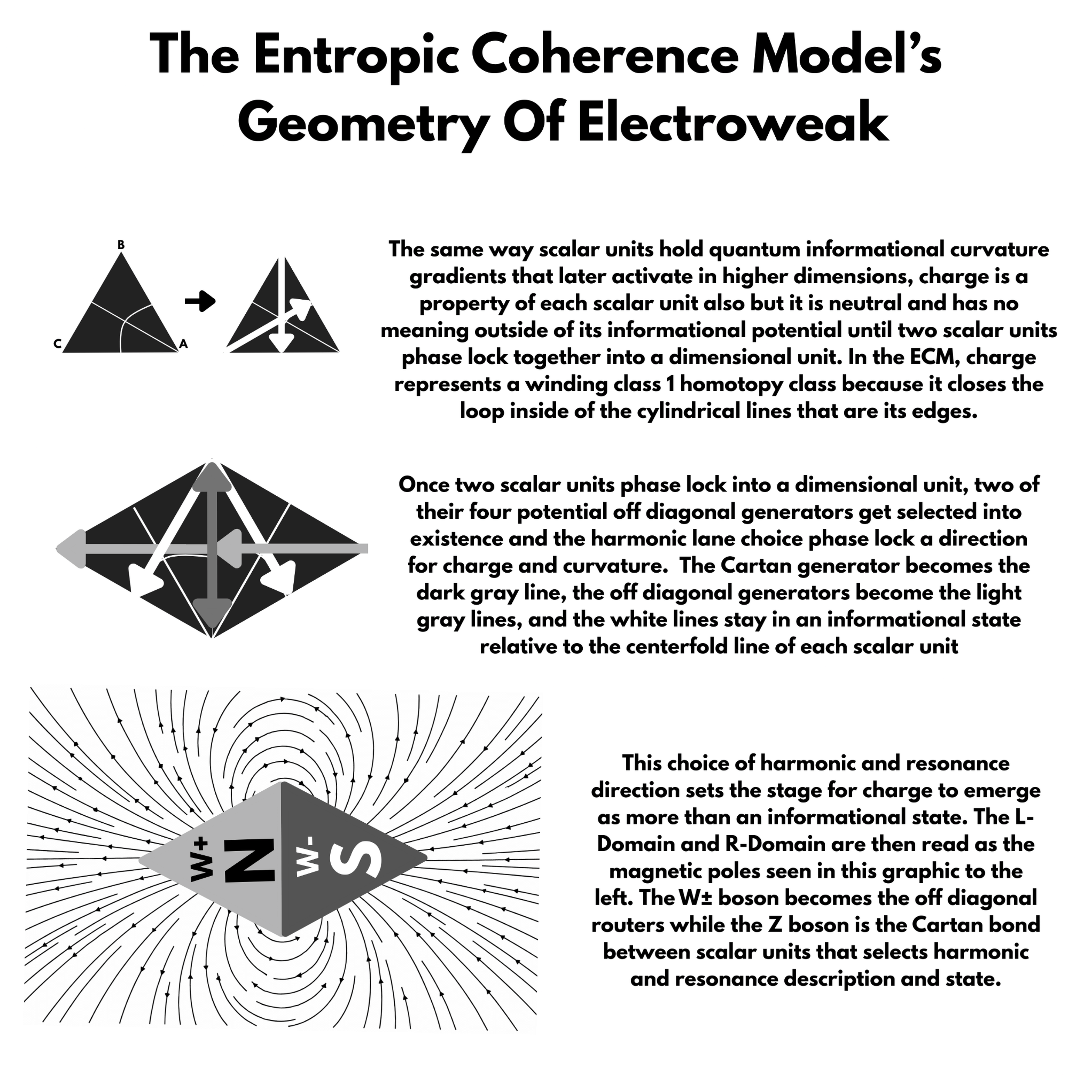
Figure 3.2
In this schematic matrix mapping, we show an example of what stacking could look like at a particle level in terms of flavors. This isn’t suppose to be taken literally as a perfect example of an actual stacking pathway.

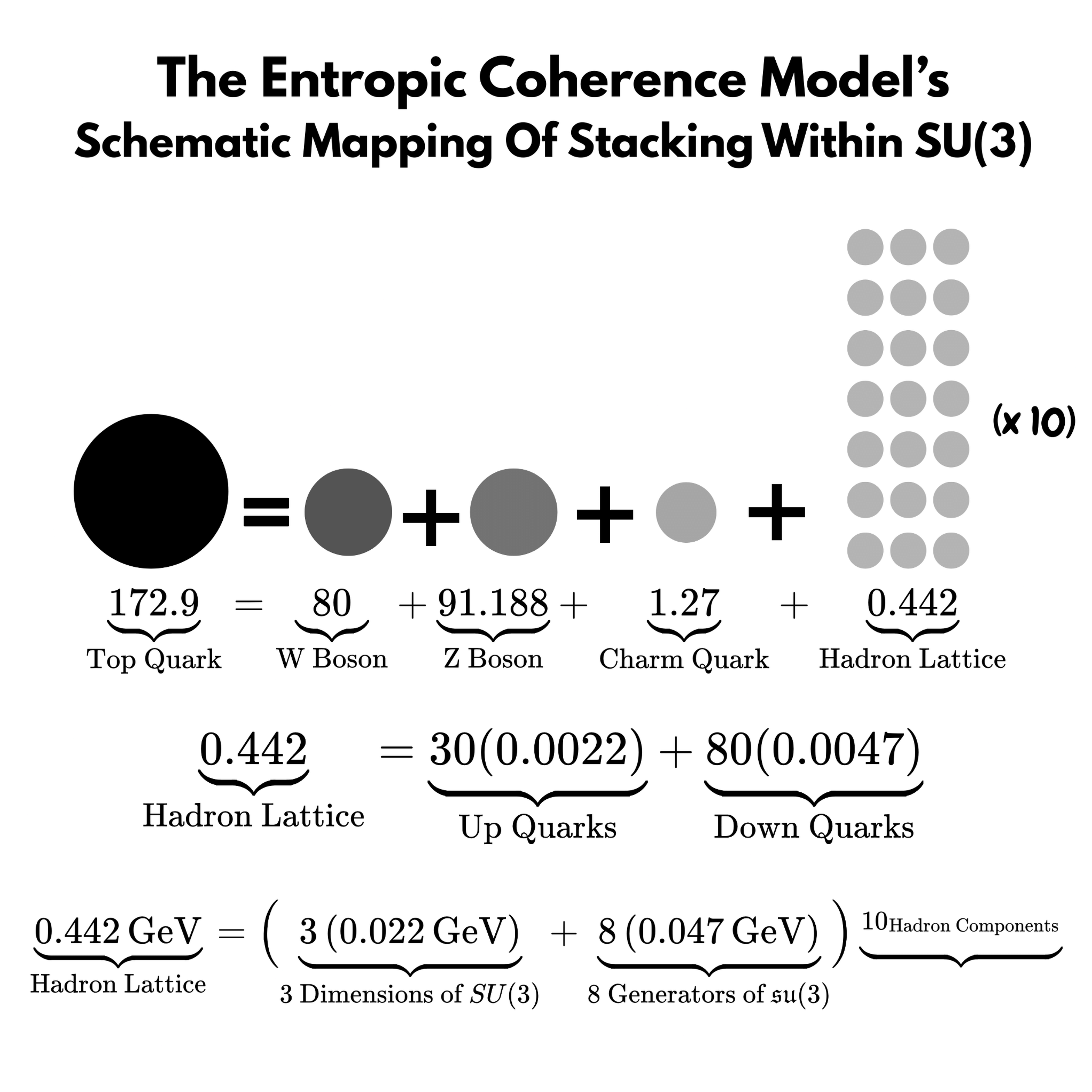
Figure 3.3
Quadrants of stacking and dispersion in the Entropic Coherence Model. Stacking can proceed by amplification inside a harmonic or by attenuating of the inverse harmonic. Dispersion can proceed by attenuating inside a harmonic or by amplification of the inverse harmonic.

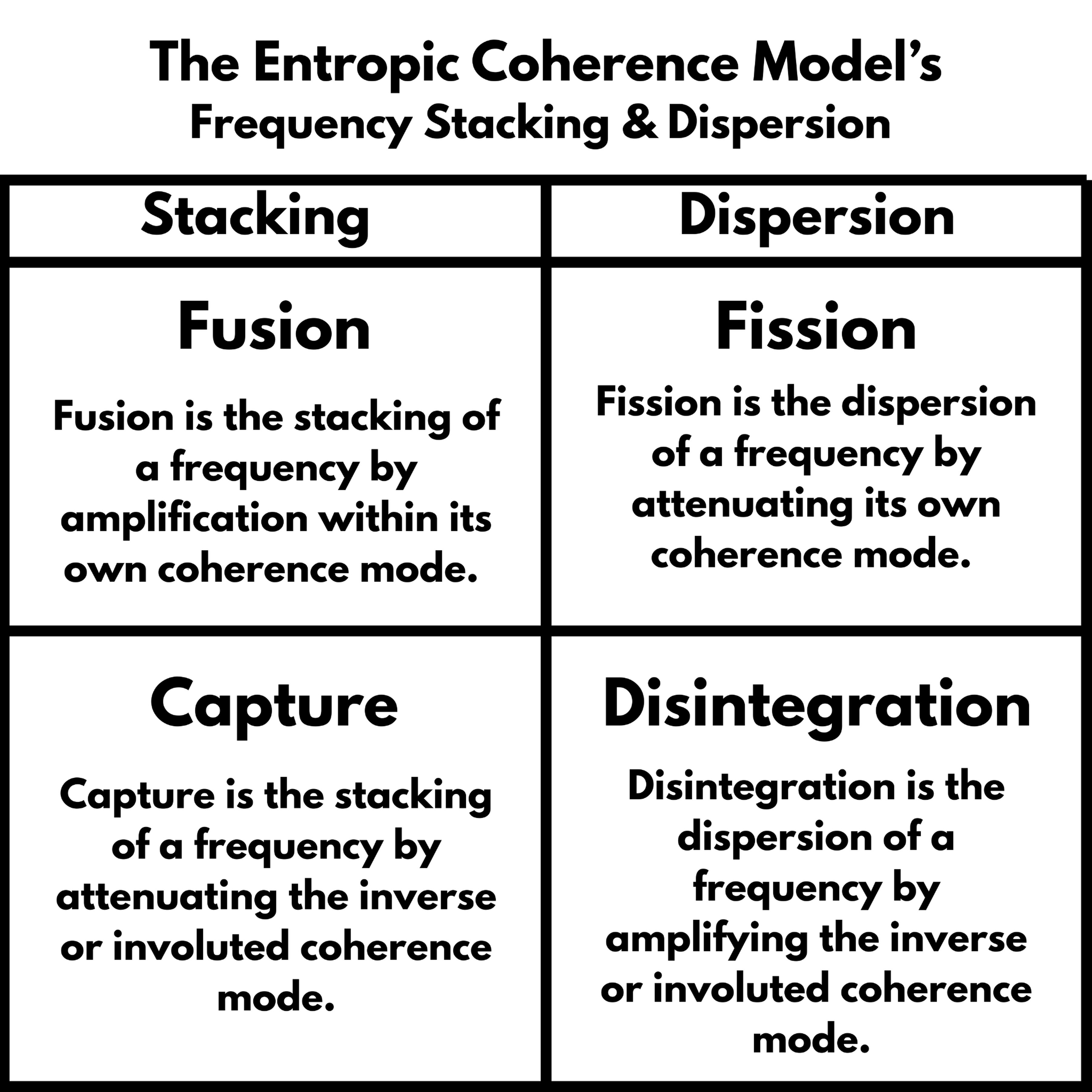
Figure 3.4
Schematic of coherence collapse in the ECM. The scalar Higgs mode carries the frequency of the collapse across the R-Domain and L- Domain harmonics. After crossing the scalar zero, envelope and dynamics are regulated by W ± and Z which possess mass and therefore record the


Figure 3.5
Flow chart for dispersion and stacking related to coherence collapse. The scalar zero is the hub. Reharmonize means settle into the same environment by retiming harmonic symmetry. Rebalance means change flavor or mass. Reposition means radiate and propagate until a region with

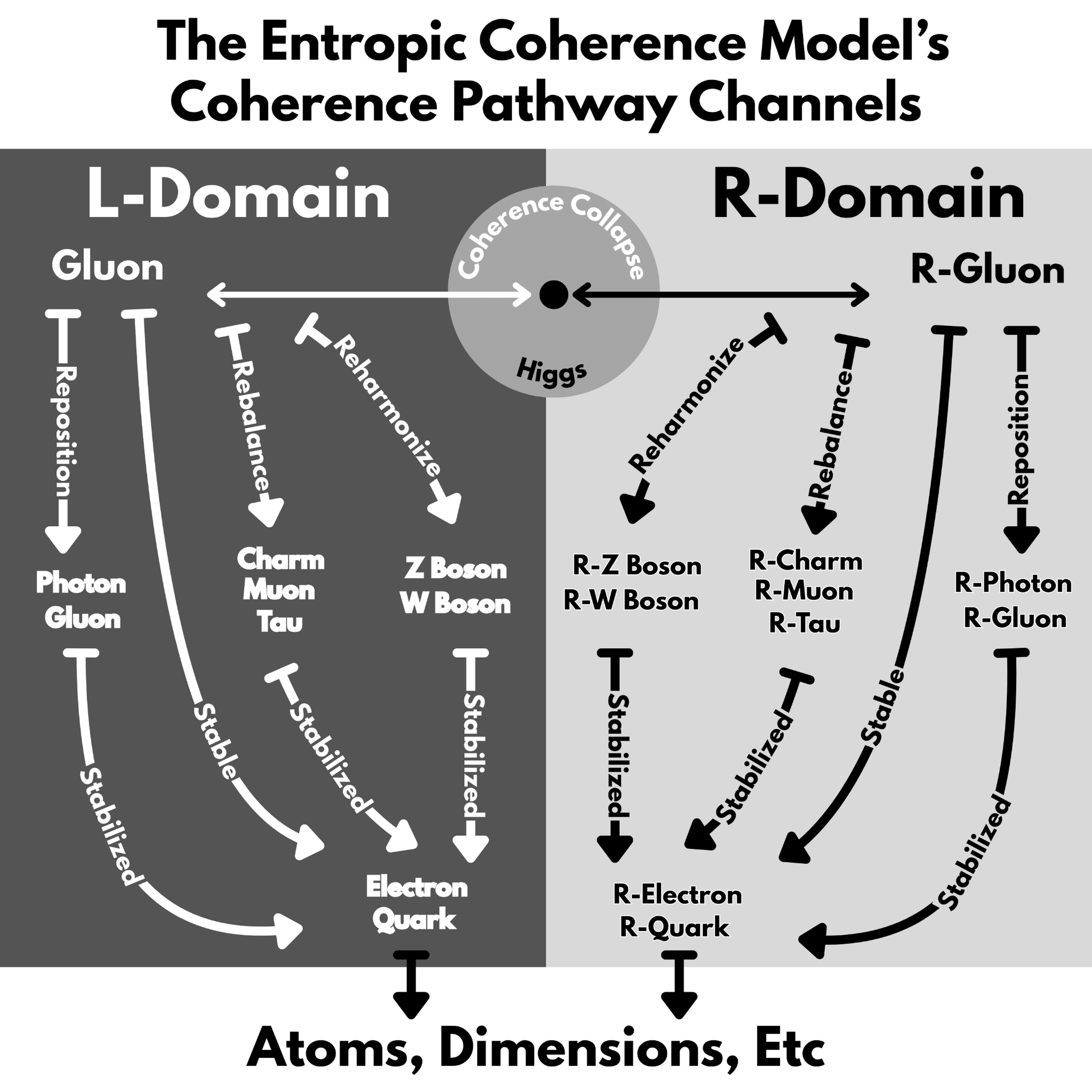
Figure 3.6
Scalar spin visualized with a three sided pyramid for SU(3). Edge routing is tracked in 60◦increments as a discrete step size on the triangular lattice, while face exchange changes which orientation is locally presented. Cartan structure tracks registry of the composite, off diagonal

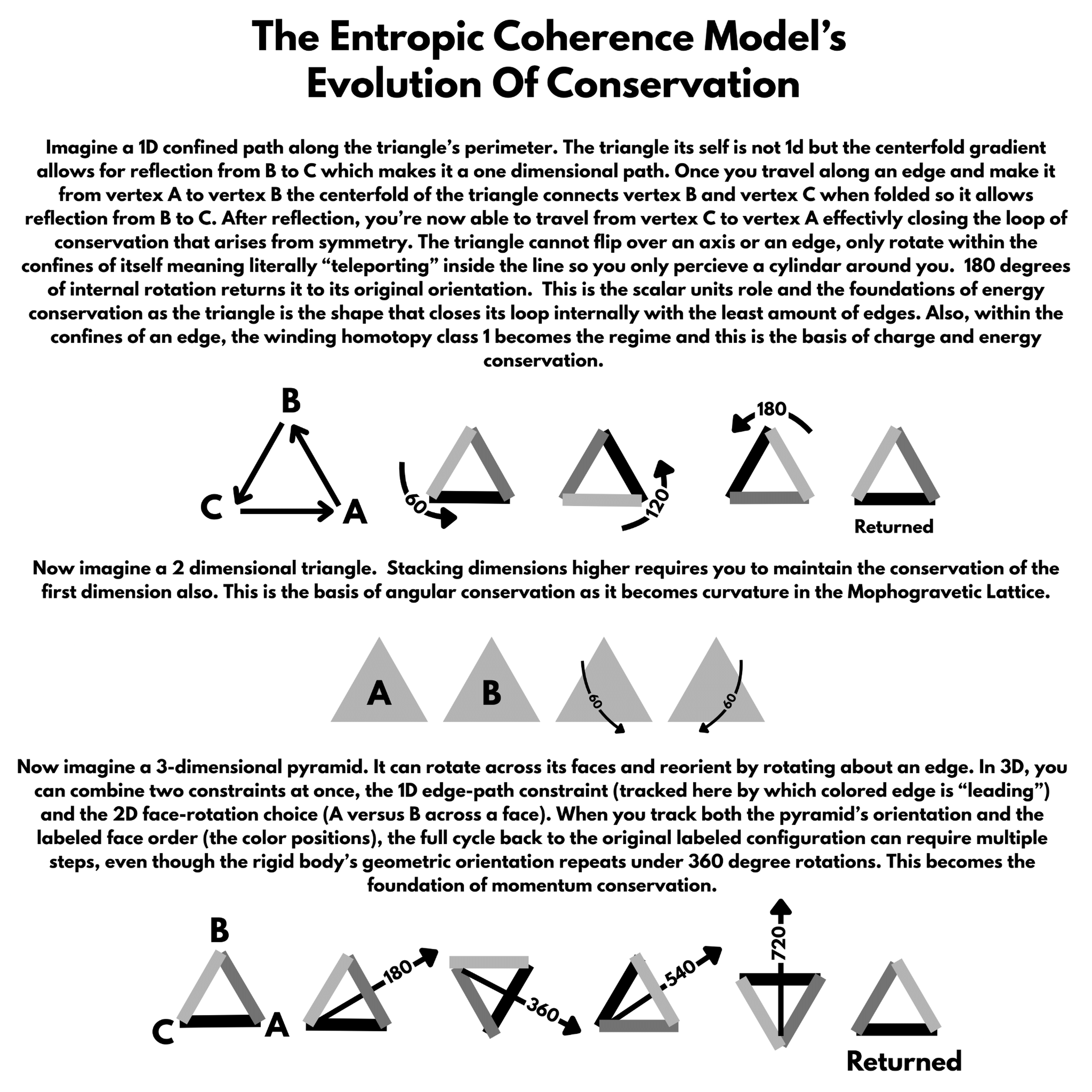
Figure 3.7
Shapes vs lines, force vs carrier, gravity vs pressure. Energy fol- lows the most efficient available route, so a straight line represents transport. When opposing flows meet, energy converts into a standing wave, illustrating matter as trapped phase. Rising coherence pressure builds generators and

